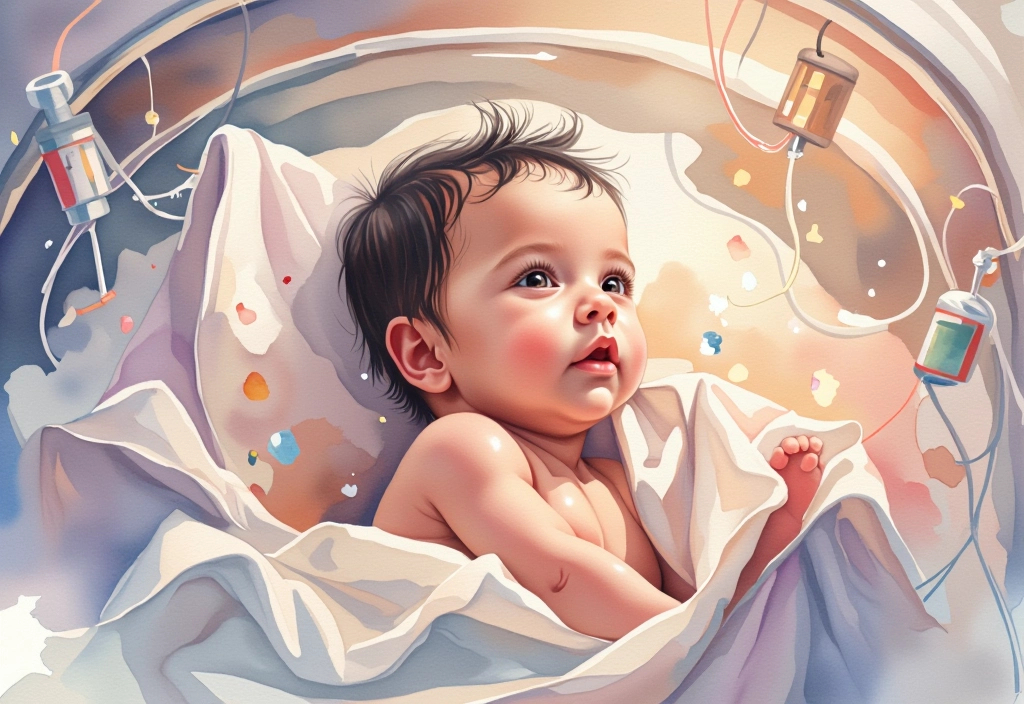
I became a mum before I ever truly held my baby. Before I kissed her cheeks. Before I traced her little fingers with my own. Ruby arrived at just 30 weeks, and nothing about her beginning looked anything like the picture of motherhood I’d carried in my heart.
We knew she was coming early. We knew she would be taken straight to the Neonatal Intensive Care Unit (NICU). I told myself I was ready — or at least as ready as anyone can be when faced with premature birth and NICU life. I thought I had braced for it, thought I’d prepared myself for the machines, the doctors, the clinical routines.
But here’s the truth no one tells you: you can’t really prepare for motherhood when it starts in a hospital ward. Nothing softens the shock of seeing your tiny baby surrounded by wires and monitors, cared for by a team of strangers when every part of you aches to be the one doing it.
Becoming a NICU mum is a collision of love and fear, pride and powerlessness. You are overwhelmed by gratitude for the medical team saving your baby’s life, and at the same time you feel an aching grief for the moments you’re missing — the cuddles, the skin-to-skin, the gentle beginnings you thought were guaranteed.
This was my introduction to motherhood: not nursery photos or first-night snuggles, but fluorescent lights, machines that beeped and hissed, and the constant reminder that my baby’s first home wasn’t in my arms but inside the walls of the NICU.
Premmie Birth, NICU Reality
Ruby’s early arrival wasn’t a surprise — but it still hit like a wave I could barely keep my head above.
Preeclampsia had already turned everything upside down. I was swollen, scared, and exhausted before she even made her entrance. My body felt like it was betraying both of us, and I was counting down the hours instead of weeks.
In the days leading up to her birth, a NICU nurse came to see me. She sat by my bed and talked through everything — monitors, wires, feeding tubes, incubators, the language of premature birth I’d never imagined I’d need to learn. I nodded along, but I was so overwhelmed that most of her words blurred together. The only thing that cut through was this: “A baby born at 30 weeks has a 98% chance of survival.”
That number became my lifeline. Ninety-eight percent. It was all I could cling to. I held it like a mantra, repeating it to myself whenever the fear rose too high. My little girl had to be part of that 98%. She just had to survive.
When she finally came — via emergency c-section — there was no dreamy “golden hour.” No skin-to-skin, no little pink hat, no baby placed on my chest. I got the briefest glimpse of her, one I can hardly even remember, before a team whisked her away to the Neonatal Intensive Care Unit. And me? I stayed behind, being stitched back together, dazed, numb, and sore.
After that came the recovery room, which felt endless. Just me, a toasted cheese sandwich, and a plastic cup of orange juice — the strangest contrast to the life-changing moment I’d just lived through. No baby in my arms. No support. Just an aching emptiness and a heart already in the NICU down the hall.
NICU life is a crash course in heartbreak and hope. And for me, it started with those words: 98%.
What It’s Like Becoming a NICU Mum
Motherhood in the NICU doesn’t begin with cuddles and lullabies — it begins with wires, monitors, and a fierce love that has to fight for space in a medical ward.
You enter a world where hushed voices replace lullabies, where every doorway demands another squirt of hand sanitizer, and where the steady whoosh and beep of machines become the soundtrack to your baby’s first days. It feels both deeply reassuring and impossibly wrong — safety and fear tangled together.
Doctors and nurses offer updates in a language you’re still learning: “She’s doing really well for her gestation.” You nod, trying to absorb the words, not sure whether to feel relief or to cry harder because “really well” still means fragile, still means fighting.
You try with everything you have left to express milk, but your body is still in shock. Nothing comes — or at least that’s how it was for me. I sat there, exhausted and raw, willing my body to cooperate, feeling like even this most basic act of motherhood was out of reach.
And some days, the only thing you can do is be there. Watching. Waiting. Reaching through the portholes of the isolette to hold a hand the size of your fingertip or cradle a foot no bigger than a thumb, because you can’t yet lift them into your arms.
It’s motherhood distilled down to presence — loving with everything you have in circumstances you never imagined.

The Firsts I Missed
What no one tells you is how many firsts you might miss.
I was still recovering from preeclampsia — trying to get my blood pressure down, trying to stay upright without fainting, trying to be strong while my body just wasn’t.
And while I rested, Ruby was growing.
I missed the first time she opened her eyes.
I missed her first bath.
I missed more moments than I can name.
I’ve had to make peace with that — and I’m not fully there yet.
There’s a quiet kind of grief in knowing that while your baby was being brave and brilliant, you were simply… healing.
And I wish someone had told me: That was brave too.
“You’re not missing out on motherhood — you’re living it in one of the hardest ways possible.”
When Things Got Worse: Ruby’s MRSA Diagnosis
Just when we thought we were finding our feet in the NICU rhythm, things took a terrifying turn. Ruby tested positive for MRSA — a hospital-acquired infection that sounded like a death sentence when we first heard the letters. I can still feel the chill of that moment, the way the words landed like a punch in my chest.
They moved her into isolation. A black tape line was placed around her basinet like a boundary between her and the rest of the ward. The nurses had to wear full gowns, gloves, and masks just to touch her. Every visit was filtered through fear, and the once-familiar NICU routine suddenly felt like enemy territory.
I started watching more closely then, noticing details I hadn’t before. The baby beside Ruby had already been quarantined, her own little corner marked out with black tape, nurses fully gowned as they cared for her. And yet somehow, despite all the protocols, Ruby still ended up sick. I noticed how staff would sometimes touch Ruby without gloves — fleeting moments, quick adjustments — before moving on to another baby not in quarantine. It was obvious to me: one small touch, one lapse in discipline, was all it took. That realisation annoyed me, angered me even. Because in a place where every detail was meant to matter, the smallest oversight had left my baby fighting something she never should have faced.
And she was so small. Too small. I remember thinking, How can she fight this too? How can a baby born at 30 weeks, barely tipping the scales, possibly survive something this harsh?
But she did.
Ruby fought. She healed. She showed us a strength I still can’t explain. While machines beeped and nurses bustled, she quietly proved herself tougher than I had ever imagined a tiny human could be.
That experience changed me. It carved something permanent into my bones. I stopped pretending I was okay. I stopped plastering over the fear with polite nods and “I’m fine.” Instead, I started allowing myself to grieve, even while she survived. Because that kind of fear doesn’t vanish once the infection clears. It lingers. It etches itself into your memory, into your body, into the way you breathe even years later.
MRSA taught me two truths at once: that fragility and strength can live side by side in the same tiny body, and that motherhood in the NICU is as much about surviving your own terror as it is about cheering on your baby’s fight.
What NICU Really Feels Like
NICU life is a paradox.
You feel grateful your baby is alive — but devastated she’s not with you.
You fall in love — but sometimes feel disconnected.
You’re surrounded by care — but feel completely alone.
You count grams, not milestones.
You live by the rhythm of expressing, sterilising, waiting, and watching.
You try to be strong, because that’s what everyone praises you for.
But sometimes, you just need to fall apart.
And let’s be honest — most of us do. In hospital toilets. In empty car parks. In the middle of the night with a breast pump humming beside us.

What No One Tells You
- NICU trauma is real, even when everything goes “well” on paper
- Missing milestones doesn’t make you less of a mum
- Healing from birth takes time, physically and emotionally
- It’s okay to feel sad, even when you’re told to feel lucky
- You can bond with your baby even during the short times you’re together
- You might always carry the experience with you… and still, you’ll grow with it
“You are already the mum your baby needs.”
Q&A: NICU Mum Edition
Q: How early was Ruby born?
A: She was born at 30 weeks due to complications from preeclampsia. We had warning she’d be early, and that helped a little — but emotionally, I was still completely unprepared.
Q: What was the hardest part?
A: Honestly? Missing things. Not holding her first. Not seeing her first bath. Not being there for so many moments. And later, her getting MRSA — that was absolutely terrifying.
Q: Did you feel bonded straight away?
A: Yes, even though I only had a few hours a day with her.
Q: What advice would you give to another NICU mum?
A: Be gentle with yourself. Rest is not weakness. Crying is not failure. You’re not missing out on motherhood — you’re living it in one of the hardest ways possible, and your baby feels your love even through gloves, wires, and distance.

Final Thoughts
NICU isn’t just a place. It becomes a chapter in your story — one that leaves a mark.
I didn’t get the start I hoped for.
I missed firsts. I faced fear.
I cried more in those weeks than I have in years.
But I also saw what it means to fight.
I saw a tiny human become a warrior.
And I saw myself become a mum — not in one magical moment, but in a hundred quiet ones, stitched together by love.
So if you’re in the NICU season right now, or still healing from one that’s passed — please know:
You are seen.
You are strong.
And you are already the mum your baby needs. 💛
If you’d like to see more pictures of Ruby in the NICU and hear more stories, follow my Facebook page.
https://www.facebook.com/EmmaDeelightAU




Leave a Reply