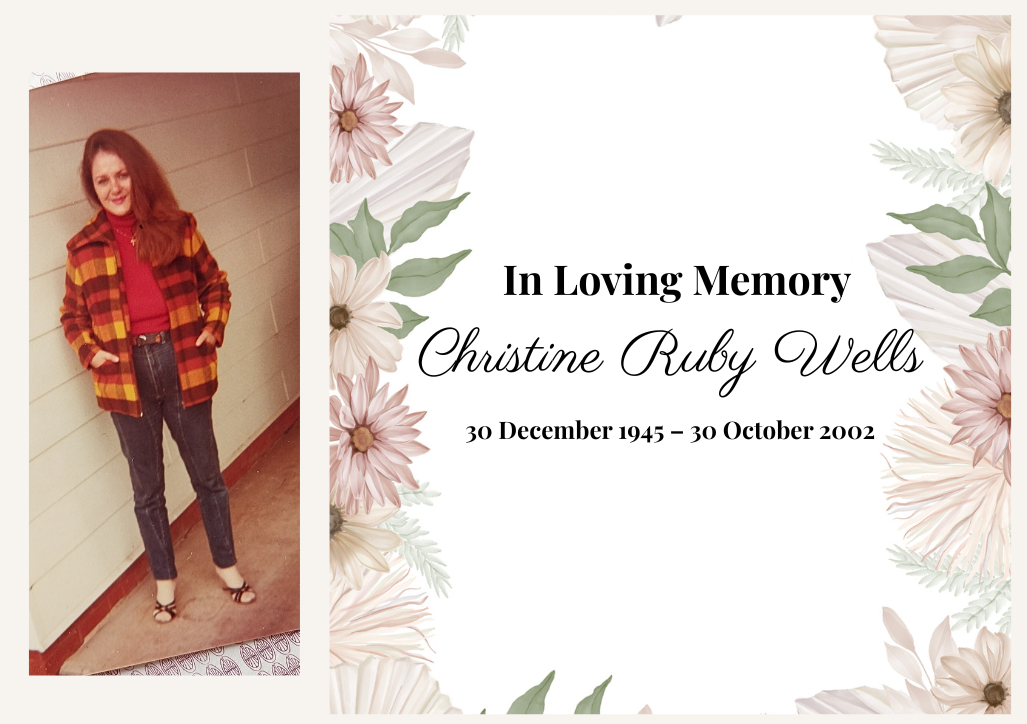
There are days that mark us forever—not with celebration, but with silence. The kind of silence that echoes louder than any scream. For me, that day came when I was 21 years old, standing in the middle of my ordinary life, completely unaware that everything I knew was about to change.
My mum died suddenly from a massive heart attack at just 56 years old. One minute, she thought she had a bit of heartburn. The next, she laid down on the sofa to rest. She never woke up.
This post is for anyone who has ever lost a parent too soon. It’s for anyone navigating grief that doesn’t always scream, but lingers quietly for years. It’s for the daughters who never stop missing their mothers—no matter how much time passes.


She Wasn’t Supposed to Die Yet
My mum was only 56.
She was still working. Still doing her grocery shopping in the same shops she’d been walking through for years. Still buying Christmas presents ahead of time and asking what everyone wanted, even when money was tight. Still doing the dishes after dinner without ever asking for help. Still watching her favourite shows from her spot on the lounge, the one that had perfectly moulded to her over time.
She was still doing life.
She did have health problems — high blood pressure, diabetes, the kind of generational stuff that quietly follows you around like a shadow. The same things I’d end up carrying too. But she didn’t look sick. Not in that way. Not in the “countdown” way. Not in the way that makes you brace for impact.
And even though her body had been giving her warnings, she did what so many women do. She ignored them. She had to. There was no budget for appointments or blood tests or medication that felt optional. So she pushed through. Swallowed discomfort. Told herself it wasn’t that bad. Took care of everyone else first. Because that’s who she was.
Mum didn’t have time to be sick.
She was still needed.
That night, everything felt normal. We had dinner. I said goodnight and I love you. I went to bed. It was just a regular evening in a regular house where nothing felt like it was about to end.
A little while later, she told my dad she had heartburn and was going to lie down for a bit.
That was it.
She never woke up.
I didn’t know that a simple “goodnight” could carry that much weight. I didn’t know it would be the last time I’d see her alive.
No warning. No sirens. Just silence.
And a thousand things I’ll never get the chance to say.
The Night Everything Changed
It was around 3am when my dad came into my room. I was still living at home, caught in a kind of survival that had always been my normal. Nothing ever felt truly safe, but nothing prepared me for this either. His voice wasn’t panicked, but it wasn’t calm. It was something else entirely — flat, hollow, unsure. He said Mum wasn’t breathing. That he couldn’t wake her.
There was no time to react, no space for understanding. I just moved. My body took over while my brain went quiet. We called an ambulance, hoping — somehow — that this wasn’t the end of the story. That they’d walk in, do something, and fix it. That she’d be fine. That I’d hear her voice again, even if it was annoyed and tired and asking what all the fuss was about.
But they arrived quickly, and there was nothing they could do. She was already gone.
I remember the word they used — gone — and how wrong it felt in the room. It didn’t make sense. Not when her slippers were still beside the couch. Not when the house still smelled like dinner. Not when I had just said goodnight, told her I loved her, and gone to bed like it was any other night. That kind of word didn’t belong here.
I didn’t cry. I didn’t collapse. I didn’t fall to the floor the way people do in movies. I just… did what needed to be done. I rang my nan and pop — my mum’s parents — and somehow found the words to tell them. I don’t remember what I said, only that I couldn’t let them hear it from anyone else. And then I left the house and went straight to them. I couldn’t stay there. Not in the place where everything had just ended without warning. I needed to be where her memory still felt like something warm, not something lost.
I stayed with them until morning. I don’t think any of us slept. We just sat in the heaviness of it. Quiet. Broken. Waiting for the sun to come up and tell us that we had somehow survived the night, even though it didn’t feel like we had.
Eventually, I went home. I walked through the door like a visitor. I remember putting my keys down on the bench and then, seconds later, forgetting where they were. It was such a strange moment, but it’s burned into my memory — that instant where my brain just shut down, like it couldn’t carry one more piece of reality. Like forgetting where I’d put my keys was the only way I could keep myself from falling apart.
The house didn’t feel like home anymore. Nothing did.
She was gone.
And nothing made sense anymore.


Grieving at 21: When You’re Still Becoming Who You Are
At 21, I was still figuring out who I was. I wasn’t married. I hadn’t had a child. I didn’t have a clear sense of direction or purpose. I wasn’t chasing a career or a dream. I was just existing — floating between days, doing my best to survive a life that had already worn down so many parts of me.
I had a boyfriend at the time, but it wasn’t a great love. Not really. More of a placeholder than a partnership. Someone who didn’t want to be alone, but didn’t really want to be with me either. There weren’t many people around my age who truly understood me — or wanted to. I didn’t have a circle of close friends or a future mapped out on a vision board. There were a few people at church who cared, though. Some of them stepped up and held me through that time like chosen family. I’ll never forget that.
But for the most part, I was alone in it.
And then, all at once, I was motherless too.
The woman who had shaped my entire life — who taught me how to make a proper cuppa, how to fold fitted sheets (or at least try), how to laugh at things that weren’t really funny but were somehow hilarious when she said them — was gone.
Losing her at that age felt like being cut loose from the only anchor I had. It was like someone had erased the beginning of my story while I was still trying to write the middle. Like I’d been set adrift with no map, no compass, and no one left to call for directions.
And when you’re that young — not a child, but not really an adult either — there’s this strange silence that follows you around. People don’t quite know how to respond. Some think you’ll bounce back quickly because “you’ve still got your whole life ahead of you.” Others treat your grief like it’s less valid because you weren’t a mother yourself yet — like it should somehow hurt less because you were still “so young.”
But it didn’t hurt less.
It hurt sideways. Quietly. Constantly.
In the empty kitchen.
In the suddenly unfamiliar house.
In the half-finished conversations that would never be completed.
Grief at 21 doesn’t look like falling apart in public. It looks like staying in bed too long. Losing track of days. Eating dinner in silence. Staring at a TV you’re not really watching. Feeling invisible even when people are talking to you. Reaching for the phone — just for a second — before remembering there’s no one to call.
But somehow, in all of that, I never doubted her love. We didn’t have things left unsaid. We weren’t in a bad place. There was no lingering tension or unfinished apology between us. She loved me. I loved her. That was clear, always.
And honestly, that’s what saved me in the years that followed — knowing that I didn’t lose someone who might have loved me one day. I lost someone who already did.
What I Miss Most
I miss her comforting hug on a bad day — the kind that didn’t try to fix anything, just made me feel like maybe I didn’t have to hold it all together for once. She didn’t need to say much. Her arms around me were enough to remind me I wasn’t alone.
I miss her laugh, especially when she said something cheeky she probably shouldn’t have. She had this way of delivering inappropriate jokes with perfect timing, like she was letting a little mischief into the room just to lighten the air. She was never prim and proper — and thank God for that.
I miss how she protected me, even if she didn’t always know the right words or the perfect way. Her love wasn’t loud, but it was steady. She’d stand beside me, even when she didn’t fully understand what I was going through. She always made me feel like someone was in my corner.
I miss the small rebellions — like the days we skipped out on school or work just because we felt like it. There was something about those moments that felt like permission to just be. No pressure. No expectations. Just the two of us, sharing time that didn’t need to be earned.
I miss the way she’d stretch out beside me at the beach on a summer’s day, soaking in the warmth and talking about nothing important at all. Those were the quiet moments that stitched themselves into my bones — the kind you don’t know are precious until they’re gone.
But more than anything, I miss the way she made me feel like I wasn’t too much, even when I was. When I was loud or messy or moody or tired or struggling — she never tried to shrink me. She just let me be. And in that space, I felt safe.
You don’t realise how much someone does — how much they are — until they’re gone. And then their absence takes up the whole room. The space they filled is everywhere now.


Grief Doesn’t Work Like You Think
Grief doesn’t follow a schedule. There’s no finish line to reach. No checklist to tick off that means you’ve “moved on.” No magical point where the pain finally decides it’s had enough and leaves you alone.
At 21, grief didn’t look the way I thought it would. It wasn’t black clothes and sobbing at a graveside. It was quieter than that. Slower. Sometimes it looked like forgetting — and then suddenly remembering. Like standing in the supermarket years later and seeing someone with her haircut or her walk, and feeling that wave of heartbreak crash all over again, right in the middle of the cereal aisle.
Sometimes it looked like anger. Not the loud, dramatic kind — but the slow, bitter kind that builds over time. Anger at the unfairness. At how sudden it all was. At the fact that the universe didn’t even give her one more day. That I didn’t get to grow up with her beside me. That she never got to grow old.
And sometimes, it looked like complete numbness. Like going through the motions, brushing your teeth, folding your laundry, doing what has to be done while the rest of the world carries on — untouched by the fact that your mum is never coming back. They don’t know. They can’t feel it. But you do. Every single day.
What I’ve come to realise — slowly, painfully — is that grief doesn’t always fade. Sometimes it stays. Sometimes it softens. But it never truly disappears. And that’s not a failure. That’s not a weakness. That’s love refusing to let go of something that mattered.
If your grief is still sitting with you years later, that doesn’t mean you’re broken. It just means you loved deeply. It means you still do.
And that’s okay. It really is.
She Deserved More Time — And So Did I
There isn’t a day that goes by where I don’t think she deserved more time. Not just more time on this earth, but more time with me. More time to laugh together as adults. More time to talk, not as mother and child, but as women navigating the harder parts of life. More time to ask her things I didn’t know I’d one day want answers to. More time to rebuild what was damaged, to soften what had been hard. We didn’t get to grow old together. And that still aches.
She deserved more cups of tea. More lazy beach days. More family dinners with too much dessert. More time to see who I’d become — after the chaos settled, after the healing began. More time to see the version of me who finally felt safe. She missed the me I was becoming.
And I missed out too.
I missed having her beside me through it all — through heartbreak and recovery, through grief and growth. I missed out on the comfort of hearing her say, “I’ve been there too,” when motherhood cracked me open. I missed the gift of getting to see her with my child — not just as Mum, but as Nan.
Because I know she would’ve been a great one.
I know that without question.
I was lucky enough to grow up with an incredible nan — my mum’s mum — and she was everything to me. Soft, strong, steady. Always there. That kind of love shapes you. And I know my mum would’ve continued that legacy with Ruby. She would’ve shown up. She would’ve cared deeply. She would’ve made sure Ruby always knew she was safe, and wanted, and loved beyond measure.


Carrying On Her Name
When I became pregnant, there was only ever one name I considered.
Ruby.
It was my mum’s middle name — and it felt like the only possible choice. Not just a tribute, but a thread. A way to carry her forward into the life I was building. To keep her name present in the chaos, the joy, the ordinary moments. To give my daughter a name wrapped in memory, and strength, and deep, steady love.
Ruby never got to meet her grandmother. But I know — I know — they would’ve adored each other. She would’ve let Ruby eat the cake batter. Bought her matching socks and tutus. Let her stay up late. They would’ve had inside jokes and shared secrets. I would’ve watched their connection from the kitchen with full heart and quiet gratitude, thinking, She’s got her.
And she would’ve had me too. My mum would’ve shown up for the messy bits. The exhaustion. The doubt. She would’ve sat beside me on the nights when I didn’t know how to keep going, and reminded me — gently, truthfully — that I was doing better than I thought.
But none of that happened.
And Ruby never got to know the woman behind the stories.
Still… somehow, she’s here.
I see her in Ruby’s spark, in her stubbornness, in her sudden tenderness that catches me off guard. I hear her in my own voice when I say the exact same things I once swore I never would. I feel her in my arms when I hold Ruby close, and in the way I love — fiercely, completely, even through exhaustion.
My mum never got to be a grandmother.
But somehow, she still is.
For Anyone Missing Their Mum
If you’re carrying a quiet grief that the world has moved on from… I want you to know, I see you.
If you still ache for her voice, her hugs, her laughter in the kitchen — if even now, years later, something small can undo you on an ordinary day — you are not alone in that.
Grief doesn’t follow rules. It doesn’t expire. It doesn’t get easier in neat, predictable stages. It simply weaves itself into your life in softer ways. And over time, you find her not just in the pain, but in the strength you didn’t know you had… in the way you show up for your kids, or the tenderness you offer others because she once offered it to you.
I find my mum now in the shape of my daughter’s smile. In the way I care for Ruby, even on the hard days. In the kind of love that lingers, even when the person is gone.
So if today is one of those days where you just want your mum — where the missing feels fresh, and the world feels a little less kind — please let this post wrap around you like the hug she would’ve given. The kind that says: you’re doing better than you think. I’m proud of you. And you are so, so loved.
A Note on Heart Attacks in Women
I wasn’t going to add this. But if it helps even one person avoid the kind of loss I went through, then it’s worth saying:
I’m not a medical expert. But I do know that what happened to my mum is far too common—and far too often missed.
Many women don’t experience the “classic” heart attack symptoms we’re taught to look for. My mum thought it was just heartburn. It wasn’t.
According to the Heart Foundation, heart disease is the leading cause of death for women in Australia—and many don’t even realise they’re having a heart attack until it’s too late.
Some signs of heart attack in women:
- Unusual fatigue
- Shortness of breath
- Nausea or vomiting
- Discomfort in the jaw, neck, or back
- Mild or unusual chest discomfort
- Light-headedness
- Cold sweat
The Mayo Clinic also shares that many women experience “silent” heart attacks—where symptoms are subtle, or mistaken for something else.
Please:
Trust your body. Ask the questions. Push for answers.
You matter.
Your mum matters.
Your daughters matter.
Let’s not miss the signs anymore.



Leave a Reply