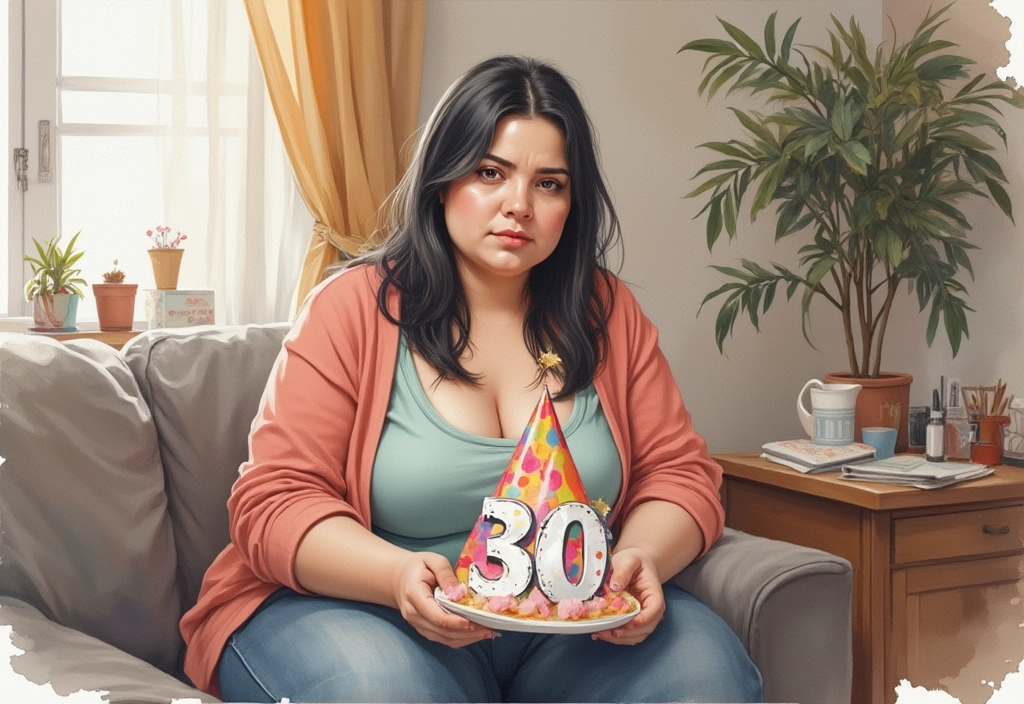
Turning 30 Felt Like a Reckoning I Couldn’t Avoid
I didn’t want to turn 30. Not in the joking, half-dramatic way people sometimes say it, but in a full-body refusal kind of way. Thirty felt like a line in the sand. A point of no return. A moment where pretending I was still “on my way” would stop working — even for me.
In my mind, adulthood had rules. It had a look. Thin. Pretty. Functional. A person with a job, a sense of purpose, friendships that weren’t quietly fading, children maybe, or at least the sense that children were still possible. Someone who knew where they were going, even if they hadn’t arrived yet. Someone who took up space without apologising for it.
I was none of those things. I was married, yes, and we had money from an inheritance, so the outside pressure to perform adulthood didn’t exist. There was no urgent need to work, no mortgage breathing down my neck, no one asking what I was “doing with my life.” But that lack of pressure didn’t feel like freedom. It felt like exposure. Like without the usual markers, there was nothing left to hide behind.
Turning 30 didn’t feel like a birthday. It felt like a verdict. Like the world — or some imagined jury — would finally look at me and say, this is it, then. This is who you became. This is as far as you got. And the fear wasn’t just about age. It was about being seen clearly, and not liking what that clarity revealed.
“Turning 30 didn’t feel like a birthday. It felt like a verdict.”
Thirty Arrived While I Was Already Slipping Out of the World
By the time I turned 30, I had already begun to disappear. I didn’t have the language for agoraphobia then — I just knew I didn’t want to be out in the world anymore. Being outside felt unsafe, humiliating, exhausting. Being seen felt unbearable. Staying home felt quieter. Softer. Contained.
At first, I thought it was temporary. A phase. A rest. I told myself I just needed time. Time away from the noise, the judgement, the constant feeling that I didn’t belong anywhere I went. I didn’t know that this withdrawal would stretch into years. I didn’t know how quickly comfort can turn into confinement.
Turning 30 landed right in the middle of that retreat. It didn’t cause it, but it confirmed it. Another reminder that time was moving forward regardless of whether I was participating. Another moment where life continued, loudly and publicly, while I was becoming smaller and quieter behind closed doors.
I think I was already grieving then, even if I didn’t recognise it as grief. Grieving the life I thought I’d have. The version of myself I believed I was supposed to become. I had always wanted to be known, cherished, chosen. I’d imagined a life with visibility — maybe even a little spotlight — and instead I felt like I was fading into the background of my own existence.
I didn’t want to be invisible. I didn’t want to be undesirable. I didn’t want to be the fat, forgotten girl that people felt comfortable ignoring — or worse, commenting on. And yet, that was exactly how I experienced myself in the world. Thirty felt like confirmation that the door to becoming someone else was closing.
The Cruise Wasn’t Freedom — It Was Borrowed Worth
For my 30th birthday, I booked a South Pacific cruise. It was my idea. I was desperate for the birthday not to happen, and if it had to happen, I wanted it wrapped in luxury. I wanted distance from my real life. I wanted the day to feel unrecognisable.
We booked a deluxe cabin. Spacious. Beautiful. High deck. Balcony. I wanted space. I wanted comfort. I wanted proof — mostly for myself — that I was someone. That I mattered. That I was worth indulgence.
On that ship, I felt like I existed differently. Not because anyone was paying attention — no one was — but because I felt important. I ordered cocktails. I drank freely. I lost money at the casino. I laughed. I let myself live in a world where everything is designed to make you feel looked after, catered to, gently elevated above ordinary life.
The cabin became my sanctuary. It felt safe and comforting, a place I could retreat to without explanation. I could sit on the balcony and stare into the ocean for hours, letting the vastness quiet my mind. I’ve always loved the sea. It gives me a sense of peace and joy that few things do. On the water, life feels suspended — like the usual rules don’t quite apply.
It wasn’t freedom. It was self-soothing mixed with self-deception. For a few days, I could pretend that having money meant having value. That luxury equalled worth. That if I could afford this, then surely I must be someone. Part of me knew it was temporary, but knowing didn’t ruin it. I needed the illusion. I needed to feel visible to myself, even if no one else noticed.

My Birthday in Vanuatu
On my actual birthday, the ship docked in Vanuatu. I don’t remember much about the morning. I don’t know if I ate breakfast. I don’t remember the details that people usually remember about birthdays. What I do remember is putting on a sundress. A black sun hat. Feeling quietly, carefully pretty.
I remember walking to shore and heading to a five-star resort for a massage — the first massage I’d ever had. It felt extravagant. Unnecessary. Exactly what I wanted. Something that marked the day as different from my everyday life.
The massage itself was relaxing, but it wasn’t uncomplicated. There was relief, yes, but also embarrassment and shame. Taking my shirt off. Being aware of my body in a way I spent most of my life trying not to be. Even if they couldn’t see the front of me, I could feel it. The weight of it. The history of judgement I carried everywhere, even into places designed for care.
I lay there trying to relax while my mind fought me. Trying to accept comfort while feeling undeserving of it. That tension — between wanting softness and believing I didn’t deserve it — was something I knew well, even then.
Afterward, I went back to the ship and ended the day with more cocktails. More distance. More pretending. The day was so far removed from my real life that it felt almost unreal, and that was the point. I enjoyed it, even though I had turned the age I didn’t want to turn.
The only person who wished me a happy birthday was my husband. I don’t remember how it felt. The fact that I don’t remember probably says more than any description could.
When the Illusion Ended
The feeling of being “someone” ended the moment we left the ship. Back home, the money still existed, but the illusion didn’t. There were no staff, no endless ocean, no cabin waiting to absorb me when things felt too much. Just me, back in my house, not existing again.
Around that time, I gave up control of the finances. It felt like relief. I was tired of being the one who dealt with everything. I told myself I’d rest, then go back to work when the money got lower. I believed that story. I needed to believe it.
But every month I stayed home, the outside world felt further away. My inner world became safer, quieter, smaller. I didn’t change physically or mentally, and because of that, the gap between who I was and who I thought I needed to be grew wider and more intimidating.
Looking back, I’m glad I had the experience I had at 30. I’m glad I wasn’t sitting in my loungeroom, marking the day in silence. I’m glad I got to feel important, even briefly. Even if it was borrowed. Even if it didn’t last.
“Once you survive disappearing,
a number doesn’t hold much power.”
Turning 40 Passed Without Ceremony
Turning 40 didn’t scare me. It didn’t even register properly. I don’t remember what I did. I don’t remember who I was with. I don’t remember the day feeling different from any other day.
By then, I was disconnected from the idea of age — but also, quietly, trying to reconnect to life. I was learning. Eating better. Doing gentle exercise. Making small, imperfect changes. There was no panic. No countdown. No sense that something irreversible was happening.
It was just a day.
Maybe because the reckoning had already happened. Maybe because I’d already lost the things people are afraid of losing at 40 — visibility, momentum, certainty. Maybe because once you’ve survived disappearing, a number doesn’t hold the same power.
When the Fear Was Already Gone
Turning 30 terrified me because I still believed becoming “someone” was something I had failed at — that there was a version of adulthood I’d missed, a life I was already too late to catch up to. Thirty felt like proof. A verdict. A door quietly closing behind me.
Turning 40 didn’t carry that weight. Not because life had suddenly become easier or kinder, and not because I had everything figured out. It didn’t scare me because the fear had already burned itself out. I had already survived invisibility. I had already lived through the loss of the life I thought I was supposed to have.
By 40, a number couldn’t threaten me anymore. It couldn’t take anything I hadn’t already lost, and it couldn’t define me in ways I hadn’t already wrestled with. There was no performance left to put on. No milestone left to negotiate with.
So forty passed quietly. Not empty — just unclaimed.
Little did I know, it would become the beginning of a whole new chapter. Baby included.



Leave a Reply