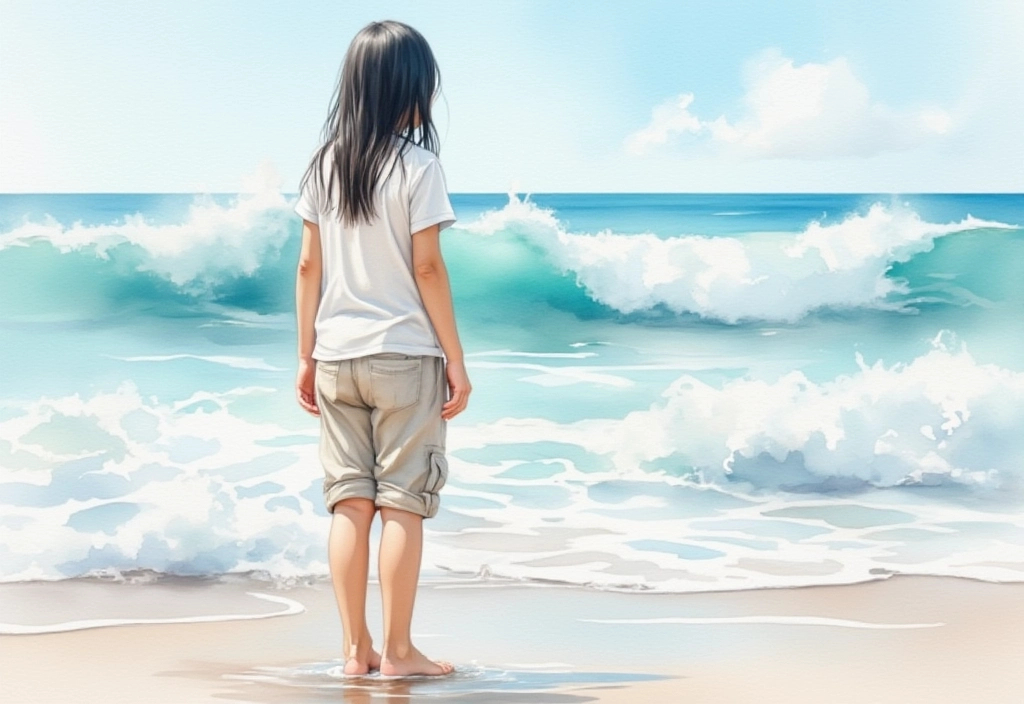
Some childhood memories soften over time. They fade gently around the edges until they feel more like stories you’ve been told than moments you actually lived.
Others stay sharp.
Not because they were dramatic or exciting, but because something about them lodged deep in your nervous system and never quite let go.
When I was twelve years old, a day at the beach turned into months of hospital visits, surgery, a cancer scare, and a quiet emotional scar that stayed with me long after the physical injury healed. Even now, when I notice the thin line of scar tissue on my arm, I am transported back to that year with uncomfortable clarity. I remember the pain, the confusion, and the strange loneliness of being a scared child in rooms filled with adults who seemed far more focused on procedures than on the small person experiencing them.
“I was twelve, in pain, and begging for my mum.
No one waited.”
The Holiday That Always Felt Safe
Every year our family holidayed at Lake Tabourie Caravan Park, a place that held the kind of magic only childhood can fully appreciate. Caravan parks have a rhythm all their own. Children drift freely between sites like tiny sunburnt nomads, barefoot and sandy, forming temporary friendships that last exactly as long as the holiday does. Adults sit outside in folding chairs, keeping half an eye on the kids while conversations stretch lazily across the afternoon air.
For us, those trips were simple and predictable in the best possible way. The beach was always the centre of everything. We walked down with towels thrown over our shoulders, raced into the water, and spent hours diving into waves until our skin wrinkled and our lips turned slightly blue from staying in too long. There was something deeply comforting about those days. They followed the same pattern every year, and that familiarity made them feel safe.
At twelve years old, I had no concept of how quickly that sense of safety could disappear.
The day I broke my arm began exactly like any other beach day at Lake Tabourie. The sand was warm beneath our feet, the waves were loud and energetic, and the ocean was full of children laughing and throwing themselves into the surf without a second thought. Nothing about the moment hinted that it would become one of the most vivid memories of my childhood.
The Wave That Changed Everything
I was body surfing, something I loved to do whenever we went to the beach. There is a particular thrill in catching the right wave, launching yourself forward, and letting the ocean carry you toward shore. For a few seconds you feel weightless, completely suspended between water and air.
I caught a wave and pushed forward, fully absorbed in that small burst of joy.
What I didn’t see was the body boarder riding the exact same wave.
He slammed directly into me.
The impact was sudden and violent. One moment I was riding the water, the next moment pain tore through my left arm with such force that it stole the breath from my lungs. The scream that came out of me was instinctive, the kind that escapes before you even understand what has happened.
Later I was told that scream could be heard all the way back at the caravan park.
At the time, I only knew that something was very wrong. The pain came in surges that rolled through my arm and into my chest. It would briefly ease just enough for me to breathe, then return with a force that made my entire body tense against it. Someone helped me back toward the caravan, where I sat clutching my arm, trying desperately not to move it.
Everyone hoped it was simply a bad knock. Kids get injured at the beach all the time. We told ourselves the pain might settle once I rested for a while.
But as the minutes passed, it became clear that something more serious had happened.
After about an hour of watching me sit there shaking and crying, it was decided that we needed to go to the hospital.

The Small Hospital
The hospital we arrived at felt strangely empty. Even now, the quiet stands out in my memory. The corridors seemed long and still, lit by harsh fluorescent lighting that made everything feel slightly unreal.
But what I remember most vividly was the feeling that the adults around me didn’t quite believe how much pain I was in.
I was twelve years old, crying openly and trying to explain that moving my arm hurt too much. When it was time for the X-rays, the technician instructed me to place my arm on the table. I tried to explain that I couldn’t lift it, that the pain was too intense, but the instruction didn’t change.
So I did what they asked.
Using my right hand, I slowly lifted my injured arm and placed it on the table. The moment I moved it, the pain surged through me so violently that I cried harder than I had in my entire life. I remember the overwhelming sense that my distress was an inconvenience rather than something that deserved understanding.
The X-rays were taken.
And then the tone in the room shifted.
The Break That Revealed Something Else
The doctors quickly realised that the problem wasn’t just a broken arm.
The X-rays showed that the bone had snapped cleanly in half because something inside it had already weakened its structure. A mass had been slowly eating away at the bone from the inside, leaving it fragile enough to break under the impact at the beach.
What we had thought was a simple accident had actually exposed something far more complicated.
There was a tumour inside my arm.
At twelve years old, the concept of a tumour is difficult to fully grasp. I understood that something abnormal had been growing inside my body and that it wasn’t supposed to be there. What I didn’t understand was how long it had been there or what it might mean.
Later we would learn that the mass had likely been growing since birth, quietly expanding within the bone for years without anyone knowing.
The hospital we were in wasn’t equipped to deal with something like that. They set my arm in a cast and instructed us to seek further treatment once we returned home.
The drive back was miserable. Every small movement of the car sent new jolts of pain through my arm. I remember sitting rigidly in my seat, trying not to breathe too deeply, as if stillness alone might protect me from the next wave of pain.
The accident at the beach had lasted seconds. The consequences were only beginning.
“Bones heal,
but the memory of being a frightened child
in a hospital room can stay forever.”
The Tests and the Fear No One Spoke About
Once we returned home, the process of medical investigation began in earnest. There were more X-rays, more scans, and appointments with specialists who spoke in careful tones about possibilities and next steps.
Each appointment meant more examination of my arm, more pressure applied to already tender areas, and more conversations happening above my head that I only partly understood.
Somewhere within those discussions was the possibility that the tumour might be cancerous.
My mum discovered that possibility in the worst possible way. She read a medical report she was not supposed to see yet, and in it were words suggesting that cancer was a very real concern.
She carried that knowledge alone for a time.
As a parent now, I sometimes think about what that must have felt like for her. To read those words about your child and then continue through the following days and appointments while pretending everything might still be fine. She protected me from that fear as long as she could, carrying the weight of it quietly while the tests continued.
I knew there was a chance it could be cancer when I went in for surgery, but I didn’t know until much later that my mum had already faced that possibility alone, reading those words on a report that should have remained closed.
Surgery and the Answer We Needed
Eventually the specialists determined that the tumour had to be removed. The surgery would allow them to remove the mass and determine exactly what it was.
At twelve years old, the idea of surgery is overwhelming in a way that is difficult to describe. Hospitals feel enormous, and everything about the environment reminds you that you are small and out of control. Adults make decisions, procedures happen according to schedules, and you simply follow the instructions given to you.
I remember lying there knowing that when I woke up, someone might tell me I had cancer.
Thankfully, that wasn’t the outcome.
When the tumour was removed and examined, it was found to be benign. The mass that had weakened my bone for so many years was not cancer after all.
It was an enormous relief.
But relief doesn’t erase trauma, and recovery was far from easy.

Healing That Took Longer Than Expected
The healing process stretched over two and a half months and proved far more complicated than I had imagined. Dressing changes were particularly painful. Often when the bandages were removed, the skin underneath had not healed properly, revealing raw areas that reopened the wound each time they were exposed.
As the bone slowly began to regenerate, it occasionally pressed against surrounding muscles in ways that caused new waves of discomfort. Even after the wound closed and the cast was removed, my arm continued to ache unpredictably for years.
The physical pain eventually faded.
The emotional memory did not.
The Memory That Stayed
Looking back now, what stays with me most vividly is not the tumour, nor even the possibility that it might have been cancer.
What remains most clearly is the feeling of being a frightened child in medical spaces that did not seem designed to notice fear.
I remember begging doctors and nurses to wait for my mum before performing procedures that hurt. I remember crying and asking them to stop for a moment so she could be there.
Most of the time, the response was simply that they needed to proceed.
At the time, it felt as though my fear was irrelevant to the process.
As an adult, I understand the pressures medical professionals work under. They are trained to focus on treatment and efficiency, often moving quickly from one patient to the next. But emotional memory does not always care about context or professional reasoning.
What stayed with me was the feeling that kindness had been absent when I needed it most.
The School Year That Disappeared
Because of the surgery and recovery period, I missed months of school during my final year of primary school. While my classmates were finishing projects and preparing for the transition to high school, I was navigating hospital corridors and learning how to manage pain that appeared without warning.
By the time I returned, the year was almost over. There was little opportunity to catch up academically or emotionally. High school arrived quickly, and I stepped into it feeling far less prepared than the other students around me.
Like many children in difficult situations, I adapted in the only way I knew how.
I simply kept going.
The Scar That Remains
Today there is still a scar on my arm, a small physical reminder of the tumour that had been growing quietly inside my bone since birth. Most people would never notice it unless I pointed it out, but I see it often enough to remember the story attached to it.
When I look at it now, I don’t just remember the beach accident or the surgery.
I remember the confusion of that year, the fear of what the tumour might have been, and the strange loneliness of navigating medical trauma as a child.
Bones heal. Skin heals. Life moves forward.
But some memories remain embedded in the quiet spaces of our past, resurfacing whenever we notice the small marks they left behind.
And sometimes, the scars we carry the longest are not the ones that show on the outside.



Leave a Reply