Growing Up in a Small World
People often imagine only children one of two ways. Either lonely little ghosts staring wistfully out rainy windows, or spoiled tiny emperors ruling over mountains of toys while refusing to share crayons with humanity. Real life is rarely that simple. Childhood rarely is.
I was an only child, and for most of my childhood, I didn’t sit around desperately wishing for brothers and sisters. That’s the strange thing about growing up a certain way. Whatever becomes your normal tends to stop feeling unusual after a while. I got used to my own company. I got used to playing alone. I got used to silence. I got used to creating entertainment for myself because there was nobody else there to fill the space.
And in many ways, I had a beautiful childhood hidden inside a difficult one. My mum loved me deeply. I never doubted that. She poured herself into trying to make my world feel magical despite the chaos happening around us. We went on outings together. We made memories together. She spoiled me with toys, books, little adventures, and moments of care because I think part of her knew I was lonely long before I fully understood it myself.
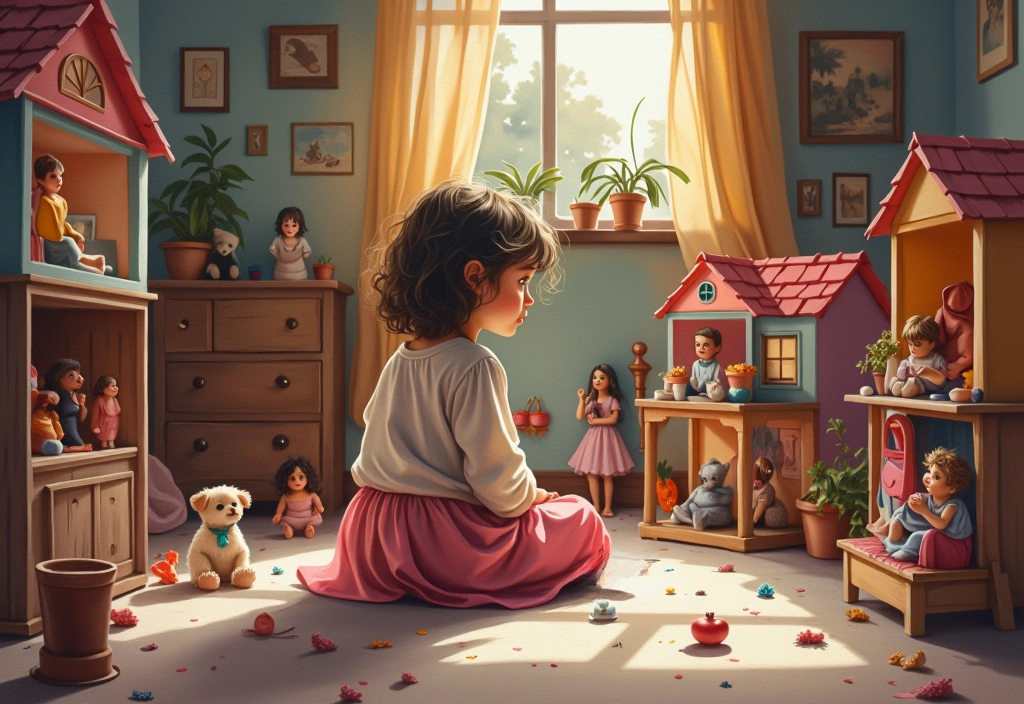
When people hear the phrase “only child,” they often focus on material things. The toys. The attention. The fact that nothing had to be shared. And yes, there’s truth in that. I had a huge Barbie collection. Entire worlds spread across bedroom floors. Mansions. Shops. Campsites. Tiny plastic towns carefully arranged into something safe and predictable. Looking back now, I realize I wasn’t just playing. I was building worlds that felt calmer than the real one around me.
“Being an only child feels very different once your parents are gone.
It feels empty in a way I never understood when I was young.”
The Child Who Became Company
My mother was my caregiver, my comfort, my safest person, and in many ways, my only real friendship growing up. My father struggled with alcoholism and violence, and homes like that become emotionally small very quickly. You don’t invite friends over. You don’t live normally. You learn early that other families function differently, even if you don’t fully have the words for why.
Because my mum wasn’t really allowed to have her own support system, much of her emotional world eventually leaned toward me. At the time, it didn’t feel unusual. I loved her. I wanted to comfort her. I wanted to make her laugh when things were hard. I wanted to fix sadness that was far too big for a child to carry.
It’s only as an adult that I’ve begun to understand how much emotional weight I was holding long before I should have been. I was constantly told I was mature for my age, and people often say that like it’s a compliment. Sometimes it is. Sometimes it’s a sign that a child has learned to monitor moods, calm tension, and emotionally adapt to unstable environments because they have no other choice.
Children in difficult homes often become emotional weather vanes. They can feel storms before anyone speaks. They know the sound of footsteps, the atmosphere of a room, the shift in someone’s breathing. They become hyper-aware because awareness feels safer than surprise. That kind of maturity doesn’t feel glamorous when you grow up. It feels exhausting.
And yet, through all of it, my overriding feeling toward my mum was always love. Fierce love. Adult perspective has complicated my childhood memories in many ways, but it has also softened some of my judgments. Now that I’m a mother myself, I understand something I couldn’t fully grasp as a child: sometimes people are drowning while still trying to keep someone else afloat.
Toys, Stories, and Tiny Escapes
I spent most of my childhood alone, but I was never truly without worlds.
My Barbies were not just dolls. They were communities. They had careers, homes, friendships, television studios, shops, relationships, adventures, and entire storylines that stretched on for weeks. I also loved Cabbage Patch dolls, My Child dolls, Sylvanian Families, and books like The Babysitters Club. Looking back now, there’s something almost painfully obvious about the themes I gravitated toward. Families. Friendships. Caretaking. Connection.
I think children often reveal their emotional needs through play long before they can explain them with language.
While other kids might have been running through noisy houses with siblings and cousins, I was quietly constructing emotional universes on bedroom floors. Tiny controlled societies where people were cared for, where homes felt safe, and where conflict could be solved because I was the one writing the story.
Books became another escape hatch. Reading let me step into lives that felt bigger and safer than my own. I dreamed about exchange programs to America. I wanted to babysit. I wanted to belong somewhere wider than the world I was growing up in. But growing up overweight, anxious, and emotionally isolated made it difficult to step into many of the experiences I longed for.
So I escaped inward instead.
People often dismiss imagination as frivolous childhood nonsense, but for many children growing up around instability, imagination becomes survival. Fantasy becomes rehearsal for hope. Stories become temporary exits. Play becomes emotional regulation disguised as entertainment.
The Loneliness Nobody Sees
The loneliness of being an only child is difficult to explain because it doesn’t always feel dramatic while you’re living it. You adapt to it. Humans adapt to almost anything eventually.
I didn’t sit around every day begging my parents for siblings. That wasn’t really the ache. The ache was companionship. Shared experience. Someone beside me inside the strange ecosystem of our home. When I saw my cousins together, laughing and bickering and existing naturally alongside each other, I remember feeling drawn toward the feeling of it more than the actual concept of siblings themselves.
Only children often become incredibly good at solitude because they have to. We learn how to fill silence. We learn how to entertain ourselves. We learn how to sit alone for long stretches without complaint because there is no alternative available. Adults often see this independence and assume it means the child is thriving emotionally.
Sometimes it simply means the child has adapted well to isolation.
And there’s another layer to growing up in dysfunctional homes that people rarely talk about: shame. You cannot easily build friendships when you are terrified someone will see behind the curtain of your household. You learn to compartmentalize yourself. To edit yourself. To hide. Even as an adult, I still struggle with acting “normal” because I spent so much of my developmental years trying to survive emotionally unpredictable environments.
That kind of isolation follows you quietly into adulthood. It becomes difficult to ask for help. Difficult to trust people. Difficult to maintain relationships because vulnerability itself feels dangerous. You crave connection deeply while simultaneously fearing judgment, rejection, or emotional exposure. It becomes a strange push-pull between wanting closeness and feeling safest alone.
“Children who grow up around chaos often build tiny worlds where people feel safe, loved, and predictable.”
The Myth of the Spoiled Only Child
Looking back now, I can absolutely see how people may have viewed me as spoiled. I had toys that were mine alone. I had attention that wasn’t divided between siblings. I had experiences that probably looked indulgent from the outside.
But the word “spoiled” feels strangely incomplete when applied to emotionally complicated childhoods.
Children can be materially spoiled and emotionally overwhelmed at the same time. Those two realities are not mutually exclusive. A child can have shelves overflowing with toys while also carrying fear, loneliness, emotional responsibility, and confusion far too large for them.
And honestly, I don’t remember being openly called spoiled very often. I think it existed more as an undertow beneath family dynamics. Quiet assumptions. Unspoken judgments. Tiny social cues that children absorb without fully understanding.
What I do remember more clearly is being called mature for my age and selfish by my father. Those labels settle into children in strange ways. Especially when they are already struggling to understand themselves inside chaotic environments.
The truth is, many only children are not selfish at all. Many become hyper-independent people pleasers who learned very early that needing too much could create emotional consequences. Some become caretakers. Some become observers. Some become emotionally self-contained because they spent years learning not to burden anyone with their feelings.
And memory itself becomes complicated too. Large parts of my childhood feel clouded now. Fragmented. Like trying to remember a house through fogged glass. Trauma does that sometimes. It preserves feelings more clearly than chronology. I remember atmospheres more than timelines. Toys more than conversations. Tension more than dates.
Losing the Only Person Who Knew You First
Losing my mum at 21 changed the emotional meaning of being an only child forever.
Until then, I had adapted to solitude. But grief exposed a deeper reality underneath it. My mother wasn’t just my parent. She was my emotional home. She was the person who knew my entire story from the beginning. The only constant care I had ever truly known.
When she died, something inside me shifted permanently.
People with siblings often have someone standing beside them in grief saying, “Do you remember when Mum used to…” They have someone who shared the same household memories, the same family language, the same emotional history. Even difficult siblings still carry pieces of the same story.
I had nobody.
And then when my father later passed away too, the feeling deepened even further. Suddenly I was the sole remaining witness to my childhood, except much of that childhood already felt fractured and difficult to remember clearly. There is something uniquely painful about realizing that the people who held your earliest memories are gone while your own memories feel incomplete too.
I barely remember what my mum sounded like now.
Writing that sentence feels unbearable, but it’s true.
I don’t have many photos of us together outside of my earliest years. I don’t have siblings to reminisce with. I don’t have someone who remembers the tiny details of our home, our routines, our jokes, our struggles, or the versions of us that existed before adulthood complicated everything.
Being an only child feels very different once your parents are gone.
It feels empty in a way I never understood when I was young.
“I became the sole remaining witness to my childhood while barely remembering parts of it myself.”
Motherhood Changes the Lens
Becoming a mother in my 40s changed the way I see my entire childhood.
Suddenly I understood my mother’s exhaustion differently. Her overwhelm. Her attempts to create magic despite living inside stress she probably didn’t know how to escape. Motherhood cracked open empathy in places where I once only held confusion.
That doesn’t erase the unhealthy parts of my upbringing. It doesn’t erase the emotional burden I carried too early. But it does create a more human understanding of her. Parenting is relentless sometimes. You can love your child with your entire soul and still feel like you are failing in a hundred invisible ways.
I know that feeling now.
And motherhood has also intensified my awareness of loneliness. Not just my own, but Ruby’s. Even though she technically has older siblings, there is a significant age gap, and I sometimes fear she will still carry pieces of emotional only-child loneliness despite not fully being one herself.
I think when you grow up isolated, you become hypersensitive to the possibility of isolation in your own children.
You notice every quiet moment. Every missed connection. Every sign that they might one day feel emotionally alone in the world.
And yet, I also know something important now that I couldn’t see as clearly before: awareness matters. Reflection matters. Emotional safety matters. My childhood shaped me profoundly, but it also gave me the ability to recognize emotional needs in ways many people never learn to see.
Sometimes healing begins there.
Craving Connection While Fearing It
One of the strangest legacies of my childhood is that I genuinely enjoy my own company while also desperately craving connection.
Those two truths exist together constantly.
I can sit alone for long periods. I can entertain myself. I can retreat into thought, creativity, stories, memories, ideas, and projects. Solitude feels familiar to me in a way that almost feels built into my nervous system. But underneath that familiarity is still a very human longing to feel deeply understood and emotionally connected to other people.
The problem is that connection becomes difficult when your earliest experiences taught you to survive independently.
I struggle to ask for help. I fear judgment irrationally. I find relationships difficult to maintain because vulnerability often feels unsafe even when I consciously want closeness. Childhood isolation doesn’t magically disappear when you become an adult. It quietly follows you into friendships, parenting, love, grief, work, and identity.
And yet, despite all of this, I still believe people need each other.
Maybe that’s why this post matters to me.
Because there are probably other only children reading this who feel guilty for struggling socially despite being “fine” growing up. People who were materially cared for while emotionally isolated. People who became mature too quickly. People who lost parents and suddenly realized there was nobody left who remembered the beginning of their story.
People who feel alone in ways that are difficult to explain.
The Last Witness
I used to think being an only child mostly meant having more toys, more attention, and more time alone.
Now I think it means becoming the last witness to your own childhood.
It means carrying memories nobody else fully shares. It means realizing that once your parents are gone, entire chapters of your life exist only inside your own mind, even when parts of that mind are still trying to survive what happened there.
It means understanding that loneliness is not always loud. Sometimes it’s quiet. Functional. Adapted. Sometimes it hides inside independence so successfully that even you don’t recognize it until adulthood shines a different light across your life.
But I also think there is something deeply human about surviving difficult childhoods and still remaining soft enough to long for connection anyway.
Despite everything, I still crave closeness. I still want warmth. I still want people who feel safe. I still want my daughter to grow up knowing she is deeply loved and emotionally held in ways I often struggled to feel.
And maybe that matters more than having the perfect childhood ever could.
Because even now, after grief, isolation, memory gaps, and years of carrying things alone, there is still a part of me building tiny hopeful worlds out of love, care, imagination, and connection.
Just like the little girl arranging Barbies across a bedroom floor, trying to create a safer world than the one she lived in.



Leave a Reply