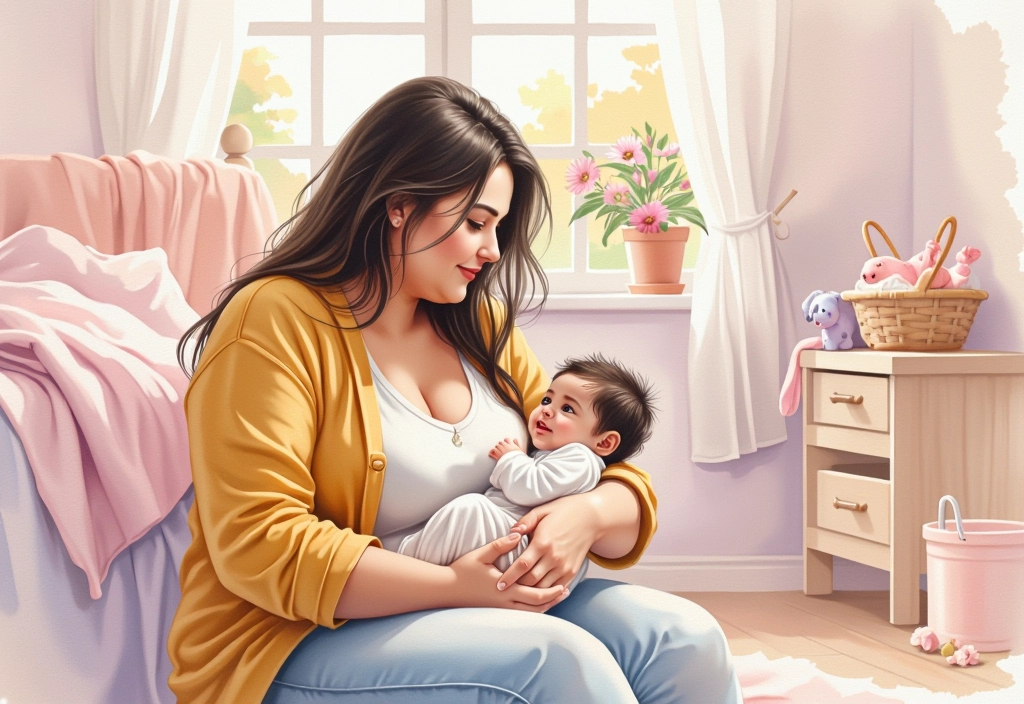
If you’d told me ten years ago that I’d be pacing the hallway at 3 a.m. with a newborn balanced on one shoulder and a heat pack strapped to my back, I would’ve laughed so hard I’d have spilled my cheap wine. Or maybe I would’ve cried into said wine. Or done both — which, frankly, is kind of the vibe of motherhood anyway.
Because here’s the truth: for the longest time, I believed motherhood wasn’t in the cards for me. Not biologically, not naturally, not even with all the hope and prayers I could throw into the universe. I had quietly started to prepare myself for a life where “Mum” was a role I’d never get to play.
And then — surprise. Plot twist. Miraculous glitch in the Matrix. At 42 years old, I became a mum. No IVF. No doctors poking around like they were assembling IKEA furniture without the manual. Just me, my partner, and one wildly determined little egg that apparently didn’t get the memo about my “advanced maternal age.”
And let me tell you — it’s beautiful. It’s messy. It’s harder than I imagined and better than I ever dreamed. If you’re sitting there wondering what it’s really like to have a baby later in life — to be the “older mum” at playgroup, to juggle nappies with perimenopause symptoms, to feel grateful and exhausted in equal measure — here’s the unfiltered, slightly sarcastic, absolutely honest version. From a woman who waited, who worried, and who now wakes up every day to a little girl she once thought she’d never meet.
I Let Go of the Dream… Then It Came True
By the time I hit 40, I had basically Marie Kondo’d the dream of motherhood right out of my future. Thank you for your service, ovaries, you may rest now. My thirties weren’t exactly “fertile goddess in a meadow” material. They were swallowed whole by agoraphobia, chronic exhaustion, and the kind of emotional burnout that makes you question whether showering twice a week counts as high achievement. Add in the slow grief of watching other people’s baby photos while quietly convincing yourself you’re “fine,” and let’s just say my highlight reel wasn’t screaming mum-to-be.
I told myself I was okay. That maybe this quieter life — the safe, small, uneventful one — was enough. I tried to picture myself as the cool auntie who always brings snacks and inappropriate stories. I imagined being the neighbour who knows everyone’s dog’s name but no one’s children’s birthdays. I told myself I was content. (Spoiler alert: I was lying through my exhausted teeth.)
Then came that day. You know the one — where your body feels off, but not in a “maybe I should cut back on cheese” way. More in a “why do my boobs feel like they’ve been inflated with a bike pump” way. I stood in the bathroom, staring down at a pregnancy test I hadn’t expected to take, and there it was: two pink lines. Not faint, not a trick of the light — two bold little streaks of rebellion saying, “Surprise, bish. You’re pregnant.”
I was 42. Stunned. Equal parts joy, panic, and wait, do I even know how to change a nappy? I had no Pinterest nursery board, no secret stash of onesies, and no clue what I was doing. But somehow, in the middle of that wild shock, I realised I was more ready than ever. Because when life sucker-punches you with a miracle at 42, you don’t argue — you grab the baby wipes and hold on for dear life.
“I showed up late, tired, and a little bit broken
but I showed up full of love.”
Pregnancy at 42: Not for the Faint of Heart
Here’s the deal: once you tick over 40, pregnancy stops being a “journey” and starts looking more like a medical Olympics — and your team is less “cheerleaders with pom-poms” and more “specialists with clipboards.” Midwives, sonographers, diabetes clinics, OBs, cardiologists — if there was an acronym, I probably had it booked in my calendar. My uterus wasn’t just a uterus anymore; it was a group project.
Gestational diabetes? Yep, signed me up for finger pricks and food charts like I was auditioning for the role of Human Pincushion. High blood pressure? Oh, absolutely — because nothing says “relax, you’re creating life” like having a cuff squeeze your arm every other day while someone tells you to avoid stress. (Sure, Janet. I’ll just cancel stress. Let me put that on my to-do list right after “grow a human.”) And don’t get me started on the blood tests. I swear I donated enough vials to stock a vampire’s pantry.
Every scan felt like Russian roulette with ultrasound gel. Equal parts excitement — is she okay, is she growing, please show me her tiny nose again — and absolute dread that something would be wrong. Advanced maternal age isn’t just a phrase; it’s basically a vibe. A vibe that says: “Congrats, you’re pregnant… but also, buckle up, grandma.”
But here’s what I need you to know: underneath the worry and the watching, I carried her with the kind of fierce, stubborn hope that only comes from waiting so damn long. I took the meds. I followed the rules. I whispered to my belly every single night, promising her the world before she ever opened her eyes.
And yes, the paperwork labelled me “geriatric.” But excuse me — I was also growing a miracle. A miracle who clearly didn’t care what year was on my birth certificate, as long as her mum showed up with grit, humour, and an endless supply of sugar-free candy that cost me an arm and a leg for the tiniest sweet melting moment.
The NICU Wasn’t Part of the Dream — But It Became Part of Our Story
Ruby clearly had her own schedule. She decided to show up at 30 weeks, a full ten weeks early, as if to say, “Sorry Mum, patience isn’t in my DNA.” Early. Fragile. Fierce. Tiny enough to make doll clothes look oversized, but somehow still bossing the room with her fighting spirit.
We’d been told to expect NICU. Doctors had explained it. Nurses had nodded knowingly. But nothing — and I mean nothing — prepares you for leaving the delivery room without your baby. The movies lie. There was no warm, gooey newborn placed on my chest, no triumphant skin-to-skin moment with swelling background music. I didn’t get to hold her. I barely saw her. One blink, and she was whisked away behind a maze of machines and doors that required security clearance.
Meanwhile, I was still swollen from preeclampsia, recovering from a body that had tried to tap out early, and wondering if my ankles would ever reappear. But do you know what my brain latched onto? Milk. Because apparently, the ultimate test of maternal worth in NICU is whether you can pump like a dairy cow under extreme duress.
Spoiler: I could not. My body was like, “Absolutely not, hun. We’re still rebooting from medical chaos. Come back later.” I sat there, hooked up to hospital-grade pumps that sounded like asthmatic ducks, and every session yielded just a few pitiful millilitres. Literal drops. Drops I collected in syringes so small they looked like props from Barbie’s medical school playset. And yes, I cried over those syringes like they were Olympic medals.
But here’s the thing: I kept going. Because when you can’t do much else, you show up anyway. I sat beside her incubator for hours, whispering love through the plastic like some sleep-deprived Romeo. I touched her tiny arm with gloved hands that felt clumsy but desperate to connect. I told her she was strong, over and over again, until eventually I started to believe it too.
I couldn’t give her much — not milk in abundance, not the fairy-tale start I’d imagined — but I could give her me. My voice. My presence. My ridiculous determination. And that, it turns out, was enough to start our story.
For the full NICU story: NICU Mum Life: What No One Tells You

Coming Home: No Nursery, No Clue, All Heart
When Ruby finally came home, it wasn’t to a Pinterest-perfect nursery with pastel rainbows and a rocking chair that screamed gentle parenting aesthetic. Nope. We brought her into a room that could generously be described as “miscellaneous storage with a bed shoved in the middle.” It was less “baby’s first haven” and more “episode of Hoarders, NICU edition.”
There was no bassinet lovingly set up weeks in advance, no wicker baskets overflowing with folded onesies. In fact, we hadn’t even moved into the main bedroom ourselves — it was still the dumping ground for everything we didn’t know what else to do with. Somewhere in that chaos, we wedged the bassinet and declared victory. Forget Instagram nursery reveals. This was survival real estate: if it fit, it sat.
There was no magical first night, either. No soft lullabies and peaceful sighs. Just one tired baby, two overwhelmed parents, and a room stacked with “stuff” that had been evicted from everywhere else. But here’s the kicker: Ruby didn’t care. She was home. And that mattered more than any curated flat-lay.
We’d waited so long for that moment, and when it came, it was a blur of joy, exhaustion, and constant chest-watching. I didn’t sleep, not because she cried — she didn’t — but because I couldn’t stop hovering like an anxious night watchman, staring at her chest to make sure it rose. Blink? Absolutely not. Breathing surveillance was my full-time gig.
And then came reflux.
Now, reflux wasn’t dramatic in Ruby’s case. There was no screaming, no back-arching banshee wails. She just… casually vomited. Quietly. Consistently. Effortlessly. Like a baby who thought regurgitation was her part-time job. Feed, burp, and boom — gentle trickle down my arm. No fuss, no theatrics. Just my laundry pile growing by the minute.
I tried it all — different feeding holds, wedge pillows, shifting timing, sending prayers to the reflux gods — and guess what? Nothing worked. The only reliable heroes in those early days? Tea towels. Not cute burp cloths with giraffes on them. Not swaddles from boutique baby shops. TEA TOWELS. Big, ugly, absorbent, straight-from-the-kitchen saviours. They were bibs, blankets, mops, shields, everything. I loved those tea towels more than half my wardrobe. Honestly, they should’ve been in the baby registry.
And here’s the truth: we still don’t have a nursery. All these months later, Ruby sleeps in our room, surrounded by love, laundry, and the faint smell of spilled formula. And honestly? That messy, imperfect setup has become our version of home. No pastels required.
“You’re not too old.
You’re right on time.”
What It’s Really Like to Be an Older Mum
Most days, I don’t feel like an “older mum.” I feel like a mum, full stop. But then I crouch down to play blocks on the floor, and my knees sound like someone’s stepped on a packet of Rice Bubbles. Or I try to stand up after twenty minutes of peekaboo, and my c-section scar plus lower back pain team up like, “Not today, sweetheart.” Motherhood may be timeless, but cartilage definitely isn’t.
That said, being a mum later in life comes with a secret weapon: presence. And not the Instagram version of presence where you light a candle and breathe deeply while your toddler finger-paints the dog. I mean the kind that comes from having already done the rounds. I’ve partied. I’ve wasted time on men who thought emotional availability was a personality flaw. I’ve lived through chaos, burnout, and all-nighters that had nothing to do with colic. And I survived it. Which means now, I’m not scrolling through old “what ifs” wondering what I’m missing. I’m here. All in. Both knees creaking, but present.
When you’re younger, it’s easy to get tangled up in milestone mania. Is she crawling yet? Shouldn’t she be rolling? Why hasn’t she mastered Mandarin flashcards by six months? But when you’re 42 with a miracle baby, you don’t care about comparing. You’re too busy marvelling that they exist. I don’t sit there stressing about her percentile on a chart; I sit there thinking, She’s here. She’s mine. She’s breathing. Holy hell, she’s really here.
And yes, I take the photo even when I’m neck deep in my mid-life chaos era.
Q&A: The Honest Bits
Do you wish you’d had a baby earlier in life?
I used to think I did. But looking back, I know I wasn’t ready — emotionally, mentally, physically. Ruby came at exactly the right time. I became a mum when I was strong enough to be one.
Was pregnancy at 42 terrifying?
Yes. And beautiful. And overwhelming. And empowering. All at once.
Do you worry about being an “old mum” at school drop-off?
Sometimes. But I also know how lucky I am to be at school drop-off at all. Perspective matters.
“Trust your timing.
You haven’t missed the boat — this is your boat.”
What I’d Tell Other Older Mums
If you’re pregnant in your 40s — or dreaming of motherhood later in life — here’s what I want you to know:
🌸 Trust your timing. You haven’t missed the boat — this is your boat.
🌸 Don’t let labels define your story. Geriatric? Please. You’re a goddess.
🌸 Advocate fiercely during pregnancy. Ask questions. Request support.
🌸 Take the photo. Your child will love it, not judge it.
🌸 Comparison is a trap. Other people’s timelines aren’t your business.
Final Thoughts (and a Warm Invitation)
Being a mum at 42 isn’t easy — but nothing about motherhood ever is. And maybe that’s the point.
What I’ve found is that motherhood is less about when you arrive and more about how you show up. I showed up late, tired, and a little bit broken — but I showed up full of love.
And that? That’s more than enough.
If you’re walking this path too — or just thinking about it — I’d love to hear your story. Drop a comment, send a message, or follow along for more honest reflections about parenting, healing, and starting over at any age.
You’re not too old. You’re right on time.





Leave a Reply