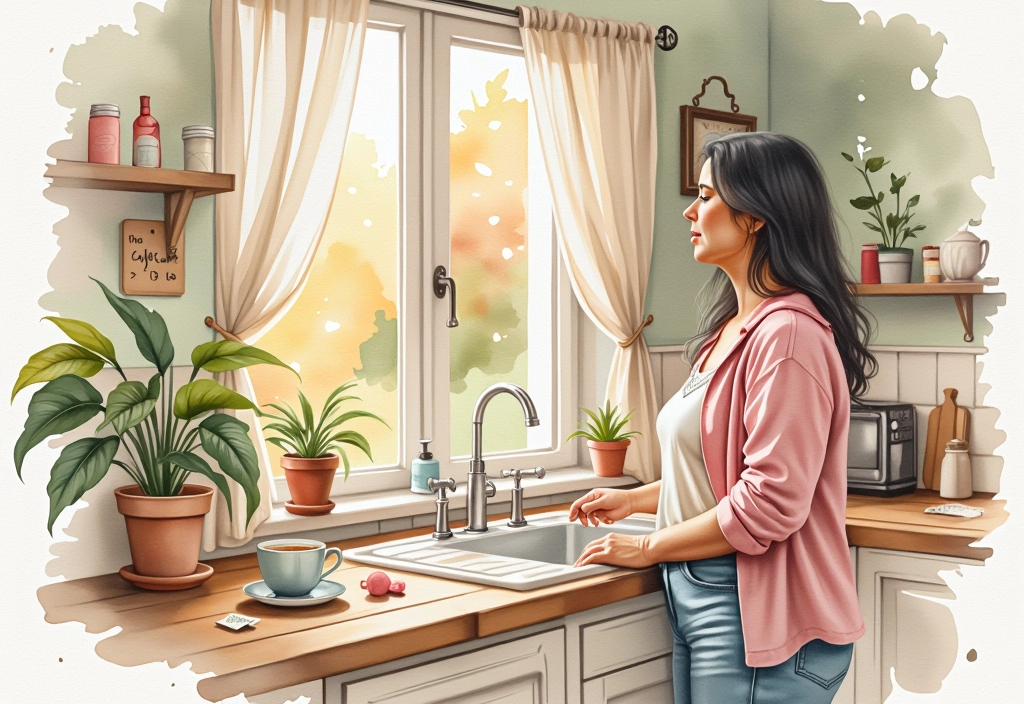
It hit me in the middle of a completely ordinary morning.
I was cleaning the kitchen — a small, normal thing — and for once, I wasn’t overwhelmed. My brain wasn’t screaming about everything left undone. I wasn’t trapped in the usual loop of hurry, guilt, and exhaustion. I just… cleaned. Calmly.
And in that stillness, something inside me whispered: This feels wrong.
That’s when it clicked. Somewhere along the way, I’d trained myself to live inside chaos so deeply that when peace finally arrived, it felt like danger.
“Chaos felt familiar.
Calm felt like a threat.”
The Body That Waits for the Next Crisis
My life right now isn’t easy, but it’s safe. There’s a roof over our heads, a fridge that’s never truly empty, a toddler who fills the air with laughter and crumbs and chaos of the healthy kind. I have work to do, stories to write, projects half-finished and others begging to be born. There’s always a list — dishes, deadlines, laundry, life. But none of it is life-or-death. Nothing about my day should make my body feel like it’s standing at the edge of a cliff. And yet, it does.
There’s a quiet tension that hums beneath everything. It’s in the background of my mornings, woven through the sound of the kettle boiling and Ruby’s chatter from the next room. Even when things are okay, I can feel it — the tight chest that refuses to loosen, the shallow breathing that never quite drops into the belly, the way my eyes scan the room as if waiting for something to spill, break, or go wrong. My body moves like it’s expecting bad news. Like peace is a setup.
It’s not panic in the dramatic sense — it’s the subtler kind, the one that hides beneath competence. The kind that makes you hyper-efficient, jumpy, too aware of time passing. It’s standing in the corner of your own life, ready to flinch at the next sound, the next mess, the next interruption. It’s a nervous system that never learned how to stand down.
And that’s the part that’s hardest to explain. Because intellectually, I know I’m safe. I know there’s no crisis brewing. I know my life isn’t the emergency my body keeps preparing for. But knowledge doesn’t rewrite instinct overnight. The truth is, I’ve spent so many years living in survival mode that calm feels foreign — not comforting, but suspicious.
My brain doesn’t register peace as “safe.” It registers it as “unknown.” And unknown has always meant danger. My mind has catalogued every quiet moment that ever turned into chaos — every calm before a storm, every silence before the next shock. So when life finally stops roaring, I can’t just rest in it. My whole system goes searching for what it’s missed.
It’s wild, isn’t it? You can spend years craving peace, and when you finally get it, it sits across from you like a stranger you’re not sure you can trust.
How Chaos Becomes a Comfort Zone
If you’ve ever lived through long-term stress — trauma, instability, illness, loss — you know this pattern. You become good at managing chaos. You get used to the adrenaline, the problem-solving, the vigilance. You start to equate exhaustion with competence.
When everything finally quiets down, your body doesn’t relax — it panics. It looks around and thinks, What am I missing? What’s about to fall apart?
That’s not weakness or drama. It’s conditioning. My brain learned long ago that being alert meant being safe. Chaos was predictable. Stillness wasn’t.
And when chaos becomes your normal, calm feels hollow. You can almost hear the hum of missing noise. The stillness echoes. Your body starts scanning for the next hit of urgency, because urgency has always been the proof that you’re doing enough — fixing, fighting, surviving. Without it, there’s an emptiness that feels unbearable, like a room gone suddenly too quiet after years of alarms. That quiet doesn’t soothe; it taunts.
So now, if things are calm, I almost feel guilty — like I’m doing something wrong by not doing more. My mind whispers that I’m slacking, wasting time, tempting fate. I catch myself inventing micro-emergencies just to feel alive again — another project, another list, another reason to stay in motion. I confuse peace with passivity, forgetting that calm isn’t the absence of strength; it’s what strength feels like when it no longer has to prove itself.

The Science of a Stress-Trained Brain
There’s a real, physiological reason for this.
When the body spends years on high alert, it reshapes itself around survival. The amygdala — the brain’s fear centre — becomes overactive, constantly scanning for threats. Meanwhile, the prefrontal cortex, which helps you reason and make balanced decisions, gets hijacked.
The result? Even when life is objectively fine, your nervous system acts like a smoke alarm that keeps going off just because the toast popped up.
You’ve probably felt it too — that constant hum of urgency over ordinary things. A messy room. An unanswered message. The sound of silence that feels too quiet to trust.
It’s not that we want chaos. It’s that our biology still believes we need it to survive.
The High of Hypervigilance
If you’ve lived in stress long enough, the body starts craving it. Not emotionally — chemically. Adrenaline and cortisol create a rush that feels like energy, focus, control. When those levels drop, the body doesn’t feel relaxed; it feels empty.
So it goes searching.
That might look like overworking, doom-scrolling, picking fights, or jumping between tasks so fast that nothing ever truly gets finished. (Hi, it’s me.)
That’s not sabotage — that’s self-soothing gone sideways. My body is chasing the familiar hum of chaos because it doesn’t yet know how to feel safe without it.
And honestly, there’s a high in it — a sharpness that makes everything feel purposeful. When I’m stressed, I feel alert, alive, almost productive in a twisted way. My brain hums with that old electricity, and for a moment, I mistake the panic for power. But underneath it, there’s a hollow ache — the quiet truth that I don’t know how to exist without being in motion. Stillness feels like a void, and my mind rushes to fill it with noise.
It’s strange to realise how easily chaos masquerades as meaning. The rush of “busy” becomes proof of worth; the constant movement becomes identity. When I strip that away — when I sit in the quiet and let everything stop spinning — there’s grief in it. Grief for the version of me who only felt valuable when she was overwhelmed, and fear that without the chaos, there might be nothing left.
“Chaos used to mean purpose.
Now I’m learning to find meaning in the quiet.”
The Guilt of Calm
Then there’s the weird guilt that comes when life is actually okay.
For people who’ve built entire identities around survival — being strong, being capable, being the one who endures — peace can feel like losing purpose. If you’re not surviving something, what are you doing?
It’s a bizarre kind of grief. You finally get what you always wanted — stability — and instead of joy, you feel a void. You find yourself waiting for the crash.
And when the crash doesn’t come, you almost start building one yourself.
The Long Shadow of Trauma
I know exactly where my chaos wiring came from.
Years of instability rewired me. Growing up in a world of anger and trauma. The long stretch of agoraphobia. A relationship that almost broke me. The constant fight-or-flight of pregnancy complications. The NICU alarms that taught me calm can vanish in a heartbeat. Every experience reinforced the same message: “Don’t relax. It’s not safe.”
My brain learned that safety was an illusion. My nervous system learned that vigilance kept me alive.
And now, in a house that’s steady and warm, with a little girl laughing in the next room, those same systems are still running like old software. They don’t care that the storm is over — they just know how to brace for one.
The Body’s Clues
When peace feels unsafe, the body tells the story first.
Mine tightens. Breath shortens. Shoulders creep up toward my ears. I move from task to task, never landing, never finishing, because finishing would mean… stopping.
And stopping feels like falling.
The only time I truly relax is when I’m eating — when flavour takes over, when I’m distracted enough to stop thinking. Food quiets the alarms for a moment. It’s not the healthiest coping mechanism, but it makes sense: eating signals to the body, We’re safe enough to digest.
It’s the one time survival mode pauses.

Learning to Trust the Quiet
So, how do we retrain a brain that confuses calm with danger?
Gently. Repeatedly. Without shame.
It starts by recognising what’s happening — not as a moral flaw or a personal failure, but as a nervous system doing its best to protect you with outdated instructions.
When I feel that creeping restlessness in stillness, I try to name it instead of reacting.
“This is safety. This is calm. Nothing bad is happening right now.”
At first, it feels awkward — like whispering to a wild animal. But over time, the body learns. Each time you name peace as safety, the alarm quiets just a little.
“My body doesn’t yet know the difference between calm and danger — but I’m learning that peace doesn’t have to be earned through suffering.”
Step 1: Let Your Body Lead
You can’t think your way into safety. You have to feel it.
I’m learning to use my body as a reminder that life doesn’t always have to be an emergency.
- The sound of Ruby playing in the next room.
- The weight of clean clothes in my hands as I fold them.
- The warmth of a cup of tea between my palms while the world stays still for a minute.
These small, ordinary moments are my proof that life can move quietly and still be safe. They’re the gentle reminders that calm doesn’t mean something’s missing — it just means nothing’s wrong.
Breathing helps too — not the forced kind that feels like homework, but the easy kind. The kind that happens when I stop noticing it. The soft, steady rhythm that says, you can stand down now.
Step 2: Reframe Rest as Progress
When your worth has been tied to doing, rest feels like regression. So I’m learning to rename it.
Rest isn’t laziness. It’s repair.
It’s my nervous system rebuilding itself. It’s proof that I trust life enough to stop controlling it for a moment.
Sometimes I literally tell myself, This pause is productive. Because for me, it is.
Step 3: Redefine Strength
For most of my life, strength meant endurance — staying upright no matter what hit me. Now, I’m beginning to believe that strength might actually be the ability to stop bracing.
- It’s the quiet confidence that the world won’t collapse if I breathe.
- It’s letting myself exist without earning the air.
- It’s folding laundry slowly without turning it into a competition against time.
This version of strength doesn’t need an audience. It’s soft, internal, and sustainable.
Step 4: Let Stillness Be Small
You don’t heal a lifetime of chaos in one meditation session.
You start by giving yourself micro-moments of safety — just enough to notice, “I survived that quiet minute.”
- Sitting in the car for an extra sixty seconds before rushing inside.
- Drinking your tea without scrolling.
- Letting the house be messy for one more hour.
Tiny acts of non-urgency. Each one adds a brick to your foundation of calm.
Step 5: Build New Associations
Peace has to become familiar before it becomes safe.
So I’m building small rituals that pair calm with comfort — music I only play when I’m relaxed, a scent that means “no urgency,” a spot in the house that feels sacred because it’s never been touched by chaos.
These are the breadcrumbs that lead my nervous system back home.

The Truth About Healing
Learning to live without chaos doesn’t mean life stops being busy or hard. It means you stop believing that busyness equals safety.
It means you teach your body that safety can exist in the middle of laundry piles and deadlines.
It means peace stops feeling like a stranger, and starts feeling like a choice.
There are days I still forget. I still chase the adrenaline, still scroll when I could breathe, still overwork until my body begs me to stop. But then I catch myself. I notice the silence. I name it safe.
And that — that noticing — is healing.




Leave a Reply