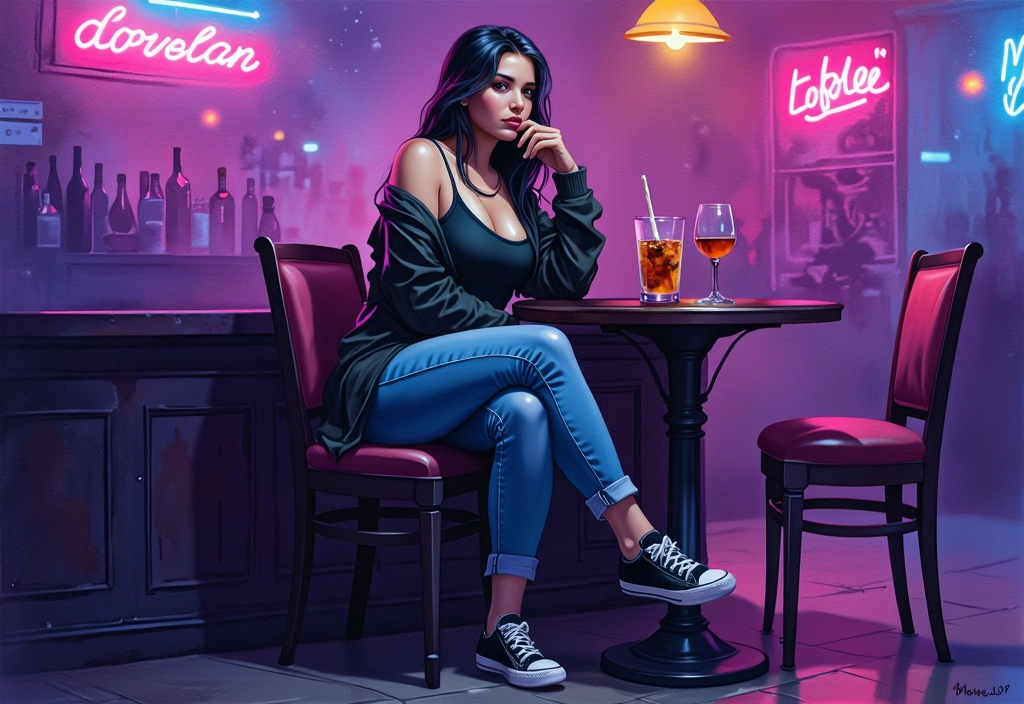
There’s a kind of loneliness that only glows under club lights.
It doesn’t look like sadness. It looks like a girl in black Converse, nursing a cheap drink at a sticky table, pretending she belongs there.
For a while, Wollongong’s nightlife felt like freedom. Three venues, a single block apart — The Glasshouse, The Oxford, and The Harp. My friends and I would rotate between them like it was a religion. $5 drinks at The Glasshouse until we earned our re-entry stamp, top 40 hits spilling into the street, the smell of cigarettes and cheap perfume. Then we’d walk to The Oxford for live bands and sweaty strangers who swore they were musicians. The Harp was the backup — the “nowhere else to go but not ready to stop” kind of place.
We’d leave home around nine, pre-drinks in the car — rum, vodka, bourbon, whatever was cheap. I’d sit in the passenger seat with my black cover shirt hiding the parts of me I didn’t want seen, trying to convince myself I looked like I belonged. By 5am, we’d be heading home, kebabs in hand, laughter fading into exhaustion.
It was fun, in the way chaos always is — right up until it wasn’t.
“Belonging isn’t something you can buy in $5 drinks.”
The Performance of Confidence
I told myself I was going out to have fun. To dance, to laugh, to let go. But underneath all that noise was something much quieter — a desperate kind of proving. Every outfit was an act of courage disguised as denim. Every drink was a prop in the performance. I wanted to be seen. Not admired, not even desired — just seen. To exist in someone’s line of sight and not feel like an afterthought.
My friends were the kind of girls who could glide through a room and leave gravity behind. Thin, beautiful, magnetic without trying. They didn’t understand what it meant to scan a room and already know you were invisible. They’d stand at the bar, laughing, tossing their hair, catching eyes that never once drifted toward me. I smiled anyway. I always smiled. Because pretending to belong is its own kind of currency — and I was good at it.
I wore my uniform religiously: a low-cut tank top that promised confidence I didn’t own, jeans that dug into a body I couldn’t love, a black cover shirt to hide what I couldn’t change, and Converse to remind myself I didn’t need heels to matter. I told myself it was an aesthetic — emo, grunge, chill — but it was really armor. A way to feel like I’d chosen how people saw me, instead of letting them see the truth.
Every laugh was a transaction. Every glance, a lottery ticket. When a man bought me a drink, I told myself it was empowerment — that I was taking control after everything I’d lost, everything that had been taken. I framed it like recovery, when it was really a relapse into seeking permission to exist. And on the nights no one looked twice, I’d feel it all — the grief, the shame, the burning envy — until the next round of shots numbed it again.
I wasn’t confident. I was committed — to the act, to the illusion, to the lie that attention meant acceptance. I stood in those crowded rooms, smiling like I had it all figured out, while every cell in my body screamed that I didn’t belong there. That I never had.

The Cost of Belonging
It’s funny how something can feel alive while it’s slowly killing you. The nights that once felt electric started to taste stale — the same music, the same drinks, the same half-hearted laughs echoing off bathroom tiles. My body was exhausted, my wallet was empty, and my heart was running on fumes. I kept showing up because I didn’t know who I was when I wasn’t that girl — the one who could stay out until sunrise and pretend she was okay.
Every Friday and Saturday became a ritual of self-erasure.
Pre-drinks in the car, pretending not to care about calories or consequences. The sting of vodka on my tongue, the warmth that followed — the only warmth I felt that week. I’d dance until my feet hurt, flirt until I felt noticed, and drink until I forgot how lonely I was. The cycle had its own rhythm, and I was both the music and the ghost inside it.
There was always a moment — every night — where the noise would dip, and I’d catch my reflection in a mirror behind the bar or in the gloss of a window. My eyeliner would be smudged, my hair stuck to my neck, and my eyes… my eyes always gave me away. They looked like someone trying to stay awake in a dream that didn’t belong to them.
One night I went to order a drink and couldn’t even remember what I’d been drinking all night. “That thing I’ve been drinking,” I slurred to the bartender, who gave me a look that wasn’t cruel — just pitying. It should’ve embarrassed me. It didn’t. It just confirmed what I already knew: I’d stopped being a person and started being a pattern.
And still, I kept going. Because what was the alternative? Staying home with my thoughts? Sitting in the silence I’d worked so hard to drown?
It wasn’t really about fun anymore. It was about escape. And the longer I ran, the smaller my world became. Friends drifted away. Conversations turned shallow. Every hangover felt heavier — not just in my head, but in my heart.
There’s a price you pay for trying to buy belonging with booze and bravado.
Mine was self-respect.
The Loneliest Hangover
It didn’t end with a bang — it ended with silence.
No dramatic falling out, no last wild night. Just a slow fade. One weekend no one texted, then another, then another. I kept checking my phone like maybe I’d missed something. I hadn’t. The people I’d called my closest friends were still out there somewhere, laughing under the same lights, but I wasn’t part of it anymore.
That’s the thing about friendships built on alcohol — they’re only solid as long as the drinks keep flowing. Once the hangovers start lasting longer than the jokes, everyone drifts back to their real lives, and you realise you were never really in theirs.
At first, I told myself it was for the best. I was tired anyway. My body hurt, my skin looked grey, my bank account was empty. I said I’d just take a few weekends off. I even convinced myself I was choosing peace — that I’d outgrown it. But the truth? I didn’t stop because I was healed. I stopped because there was no one left to go with.
When the invitations stopped, the silence hit harder than any hangover I’d ever had. Friday nights used to hum with possibility — outfits laid out, music blasting, drinks lined up. Now they were just… quiet. The kind of quiet that makes you face yourself.
I still drank, but now it was at home. Alone. Same rum, same bourbon, same glass — but without the crowd, the chaos, the noise to drown out how small I felt. The first time I poured a drink just to fill the silence, I realised how pathetic it was. And I did it anyway. Because the truth was, I didn’t know how to sit with myself sober.
Those nights at home were worse than the worst club hangovers.
There’s no music to distract you. No one to make you laugh it off. Just your own reflection in the dark window — a girl who’d spent nearly a year trying to be wanted and ended up completely alone.
The hangover wasn’t in my head anymore. It was in my chest.
It was the ache of knowing I’d spent so much energy trying to impress people who didn’t care, chasing connection in places that couldn’t give it. I wasn’t free — I was empty.
And that emptiness lasted years.
“I mistook noise for connection.”
What I Thought I Was Escaping
When I look back now, I can see it so clearly — I wasn’t chasing fun. I was running.
The lights, the laughter, the crowded rooms — they were all camouflage for the ache I didn’t know how to name. My mum had died not long before that era began, and there’s no manual for that kind of loss. Grief rearranges the world in ways that don’t make sense. I didn’t know where to put all that sadness, all that guilt, all that anger at life for being so unfair. So I poured it into weekends. Into noise. Into bottles.
When you lose someone who’s supposed to anchor you, you start reaching for anything that will stop the spin. For me, that became attention. It didn’t matter if it came from friends, strangers, or the wrong kind of men — any moment of being seen felt like a breath of air in the drowning. I told myself I was “just having fun,” but deep down I was trying to replace something that can’t be replaced. You can’t fill a mother-shaped hole with rum and borrowed affection. But I tried. God, I tried.
I was also trying to escape my own reflection. I hated the way I looked — the way I felt like a walking apology for existing in a body that took up too much space. When you feel invisible everywhere else, the club lights offer a different kind of mercy. They blur the edges. They turn every body into a silhouette. Under the strobes, you can almost believe you’re equal. You can almost believe no one’s judging.
But the thing about escaping is that it never actually gets you anywhere. It just delays the crash. And when the music stopped, everything I’d been avoiding was still there — heavier than before. The grief. The loneliness. The belief that I was too much and not enough all at once.
Every shot I took was really a prayer: please let me forget.
Forget how lonely I was. Forget the years that had hollowed me out. Forget that no matter how hard I laughed, no one was coming to save me.
And the cruellest part?
For a while, it worked.

The Things You Don’t Think Will Happen to You
When you’re caught up in that lifestyle, you tell yourself you’re in control. You’re not like those people — the ones who go too far, the ones who embarrass themselves, the ones who make headlines in the local gossip. You believe that somehow you’ll stay just on the right side of the line. But the truth is, the line gets blurrier every weekend.
You don’t think about the friends who will fade away, one by one, when the hangovers start to feel heavier than the fun. You start as inseparable, swearing you’ll be “besties for life,” and end as strangers who occasionally like each other’s photos out of politeness. When your friendship is built on late nights and cheap drinks, it doesn’t survive the morning light.
You don’t think about the choices you’ll make when your judgment slips — the kisses you didn’t mean to give, the people you didn’t really want, the mornings you’ll wake up feeling like your body isn’t your own. I told myself I was taking control after everything that had happened to me, but alcohol doesn’t give you power — it takes it. It blurs consent, dulls self-respect, and leaves you with regrets you can’t joke away.
You don’t think about the arguments that turn ugly — raised voices that echo off concrete walls, someone throwing a drink, someone crying in a bathroom stall. You don’t think about the nights you’ll lose control, slurring words, stumbling, saying things you’ll wish you could swallow back. I saw it happen to others, and I still thought I was immune. I wasn’t.
And then there’s the darker side — the people who see your vulnerability as an opportunity. The ones who take advantage of you when you’re too drunk to defend yourself. You think you’ll never be that girl. You think you’re too careful, too smart, too aware. But predators don’t look like monsters until after the damage is done.
You don’t think about the money either — the slow leak of your bank account. The taxi rides, the bar tabs, the outfits you bought trying to feel pretty. You wake up Monday broke, tired, and wondering what you even got out of it.
And then there’s the humiliation that sneaks in at the edges — the vomit on shoes, the makeup running down someone’s face, the friend-of-a-friend who threw up right there at the bar table while everyone watched. I remember stepping outside that night, the smell of it still in the air, thinking, what are we even doing?
But you go back anyway. Because you tell yourself those are isolated incidents — that those things happen to other people. Until they happen to you.
The nightlife doesn’t warn you about its fine print. It doesn’t tell you that the cost of escape is often dignity. And by the time you notice, you’re already paying for it in ways you can’t refund.
If I Could Tell You One Thing
If I could tell you one thing, it’s that joy doesn’t come in shots. It comes in safety.
I know how tempting it is to believe that chaos equals freedom — that staying out late, being loud, and living without consequence means you’re finally alive. But the truth is, freedom isn’t found in how far you can push yourself; it’s in how gently you can hold yourself when no one else is watching.
The parties end. The lights fade. The faces blur. What stays is the way you felt when it was over — the quiet, hollow echo that follows every high. I used to think I was building memories, but what I was really building was exhaustion. I mistook attention for affection, noise for connection, and chaos for confidence. I was constantly trying to prove I was fine when I was anything but.
If I could go back and sit beside that younger version of me — the one in the black cover shirt with shaking hands and a practiced smile — I wouldn’t scold her. I’d tell her she was never unworthy, just unhealed. I’d tell her that belonging built on pretending will always collapse, and that love, real love, doesn’t require performance. I’d tell her to stop giving away her energy to people who only notice her when she’s lit up by neon.
To anyone standing where I once stood — half-dressed in confidence, half-drowning in insecurity — I want you to know that you don’t have to keep proving your worth in places that profit from your pain. You don’t have to chase connection through the bottom of a bottle or in the eyes of someone who’ll forget your name by morning. There’s a different kind of joy waiting for you — one that’s quiet, steady, and real.
You will find it in the safety of people who see you without makeup, without noise, without trying. You’ll find it in mornings that don’t require recovery, in peace that doesn’t need to be earned, in the strength it takes to stay home when the world tells you you’re missing out.
Because you’re not missing the party.
You’re finding yourself.




Leave a Reply